Ensure Your Compliance to IEC 60335-1 with TÜV Rheinland
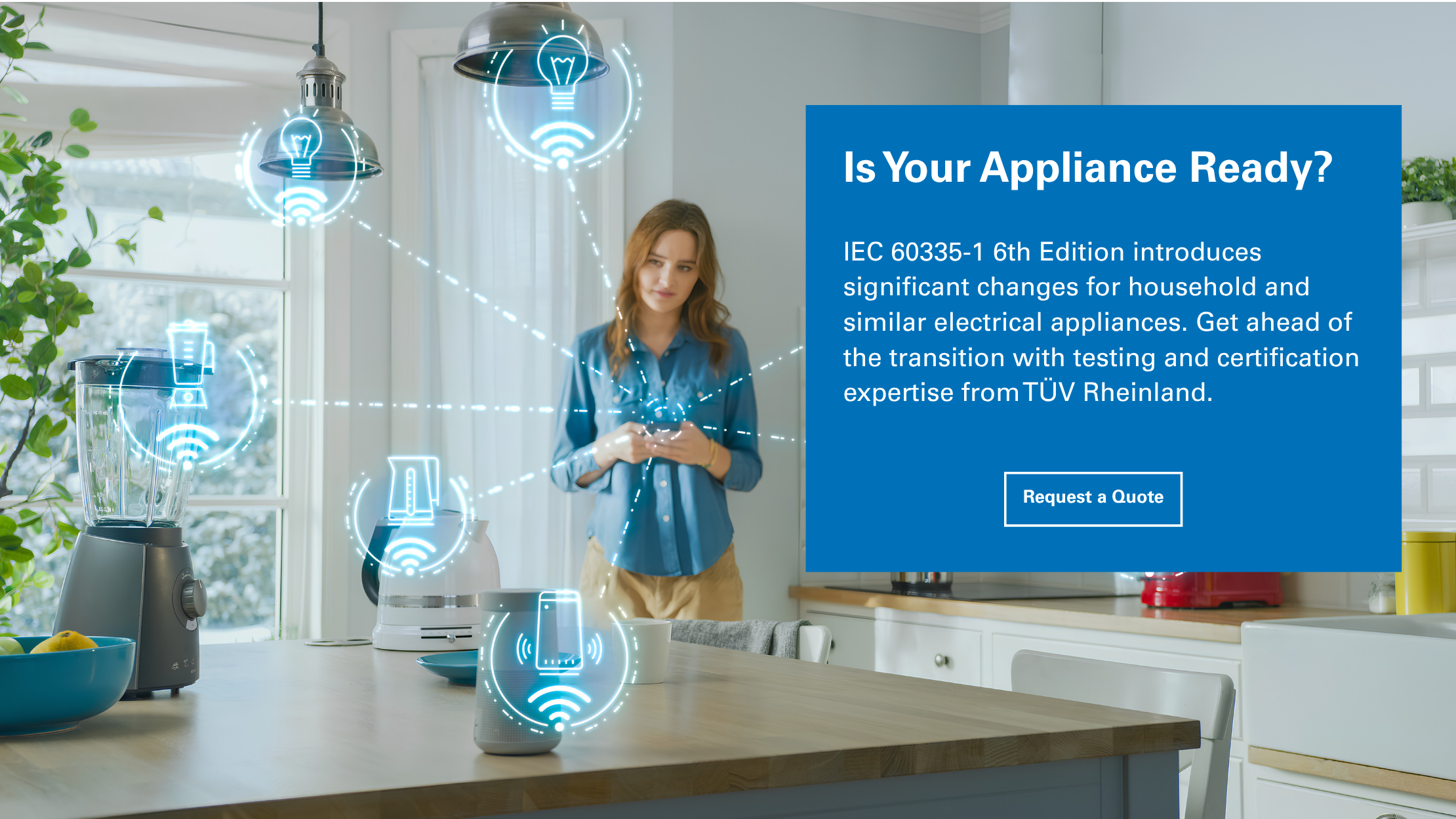
The sixth edition of IEC 60335-1 applies to a broad range of household and similar electrical appliances, from rechargeable milk frothers and air fryers to commercial kitchen machines and Wi-Fi-connected ice makers.
Published by IEC Technical Committee 61 on September 2, 2020, it replaces the fifth edition (2010, plus Amendments 1:2013 and 2:2016). More than 30 Part 2 standards have already been updated to align with the sixth edition.
This edition introduces significant technical changes, not just editorial revisions. Its foreword identifies 20 categories of technical changes, and Clause 1 now explicitly covers DC-supplied and battery-operated appliances. Because Part 1 is applied together with the corresponding Part 2 standard, manufacturers are affected only when that Part 2 standard has also been updated to the sixth edition.
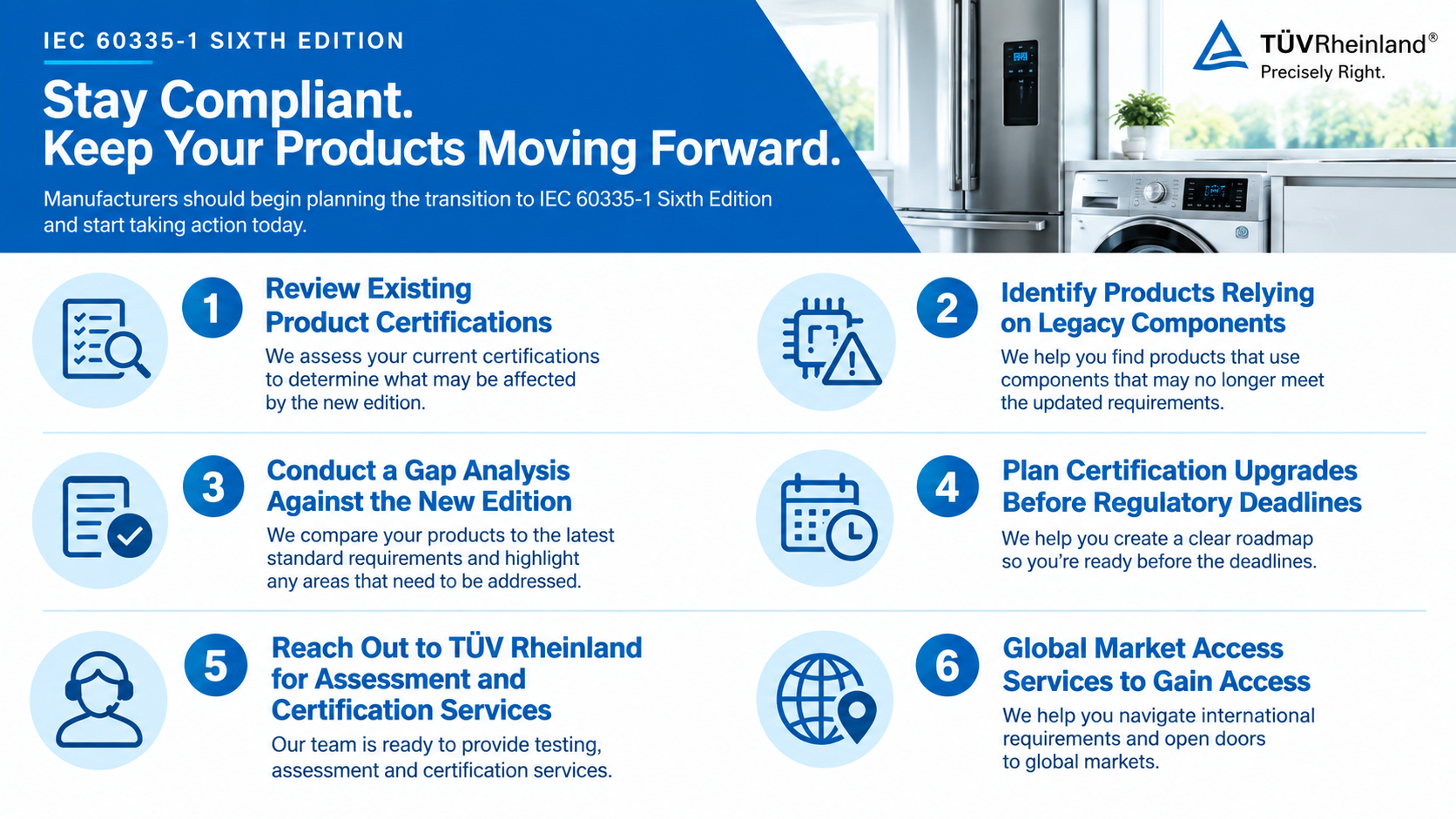
To ensure your compliance to the latest edition reach out today for a certification review with our team.
The Evolution of Safety Standards for Household Appliances
IEC 60335-1 follows a base standard and particular requirements structure. Part 1 defines the general safety requirements, while each Part 2 standard supplements or modifies them for a specific product category.
The sixth edition of Part 1 applies only when the corresponding Part 2 standard has also been updated. Products certified under Part 2 standards that are still based on the fifth edition remain subject to the existing requirements until the corresponding Part 2 standard is updated to the sixth edition.
How TÜV Rheinland Experts Can Help
Key Changes in the 6th Edition
Software-Controlled Safety Functions
Electronic and programmable controls are increasingly used for functions that were traditionally achieved by mechanical components. As these controls become more involved in product safety, the related electronic circuits and software also need to be considered in the safety evaluation.
With the sixth edition and updates to the relevant Part 2 standards, software evaluation is required for more safety-related functions. The evaluation may involve Clause 19.11, Clause 22.46, Annex Q, and Annex R, depending on the product design and applicable Part 2 requirements. Circuit faults, component failures, and software errors need to be considered when they could affect a safety-related function.
With the sixth edition and updates to the relevant Part 2 standards, software evaluation is required for more safety-related functions. The evaluation may involve Clause 19.11, Clause 22.46, Annex Q, and Annex R, depending on the product design and applicable Part 2 requirements. Circuit faults, component failures, and software errors need to be considered when they could affect a safety-related function.
Smart and Connected Functions
Wi-Fi and app-based controls are becoming common features, allowing appliance functions to be monitored or operated remotely.
Clause 22.62 and Annex U addresses appliances that communicate through public networks. The safety evaluation considers which functions can be operated remotely, the condition of the appliance when a remote command is received, how the command is handled, what happens if communication is interrupted, and whether safety-related functions remain protected.
This means connected functions need to be considered as part of the overall product safety evaluation, not only as communication or convenience features.
Battery-Powered Designs
Battery power is increasingly used to support cordless and portable operation, bringing additional considerations beyond those of traditional corded designs.
Clause 12 and Annex B include specific requirements for metal-ion battery-operated appliances. The evaluation covers charging conditions, battery protection, abnormal operation, enclosure safety, and mechanical strength.
For manufacturers moving from a corded design to a battery-powered design, these requirements may result in additional safety evaluation and testing.
Many modern appliances combine these technologies. For example, a robotic vacuum cleaner may include software-controlled safety functions, battery power, and app-based connectivity in the same product. These functions need to be considered together as part of the overall product safety evaluation.
Other Important Changes
The sixth edition also introduces or revises requirements in several other areas:
Test Probe 18 (Clause 8.1.1) – additional checks for mechanical and electric shock protection.
Moisture resistance (Clause 15.1.2) – revised IP testing affecting designs such as automatic cord reels and integral plug pins.
Mechanical strength (Clause 21.1) – revised requirements for free-fall testing of parts incorporating integral plug pins.
SELV and USB outputs (Clause 19) – additional limits on accessible low-voltage outputs.
Optical radiation (Clause 32.2) – requirements for appliances using UV or other light sources.
Resources
Would you like to learn more about the IEC 60335-1 Sixth Edition? Access more details here.

PDF
IEC 60335-1 Sixth Edition (2020): Technical Changes and Global Market Access Impact on Household and Similar Electrical Appliances
Back to top