
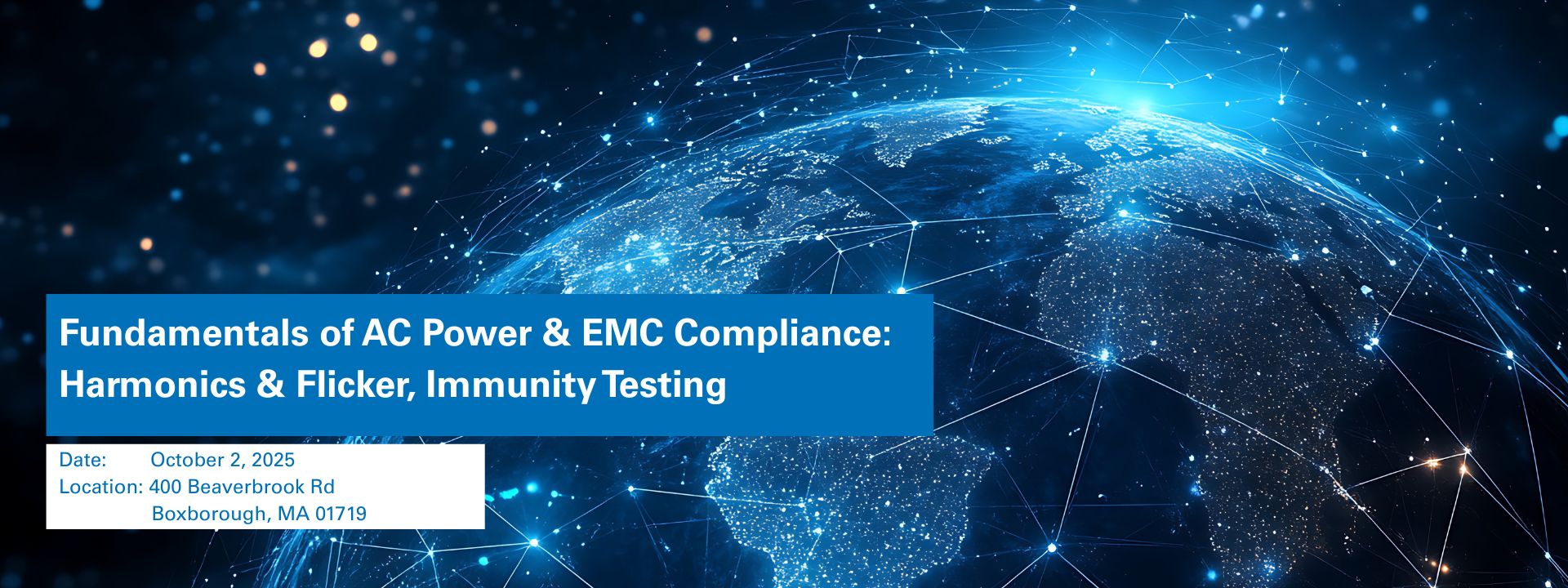
Join TÜV Rheinland and Pacific Power Source for a focused, hands-on seminar designed to equip engineers with the essential knowledge needed for AC power source and EMC compliance: harmonics and flicker, immunity testing.
What You’ll Learn:
AC Power Source Best Practices & Fundamentals
- Key functions and capabilities of programmable AC power sources
- Best practices for achieving accurate, repeatable test results
- Safety considerations and risk mitigation
- Common mistakes—and how to prevent them
- Setting up power source profiles for global AC standards and CE-marked products
- Compliance testing (IEEE1547.1, UL1547 SB, IEC/EN/GB 61000; MIL-STD 704, RTCA DO-160; SEMI-F47, and more)
EMC Compliance: Harmonics & Flicker Testing
- Overview of IEC 61000-3-2, -3-3, -3-11, and -3-12 compliance requirements
- Understanding class A/B/C/D harmonics testing
- Ensuring source accuracy and low output distortion (per Annex A requirements)
- Test procedures, setups, and pass/fail criteria
- Interpreting test results, generating reports, and audit-readiness tips
- Practical test system setups for both low- and high-current DUTs (up to 75 A/phase)
- Benefits of Pre-compliance H&F Testing (In house pretesting of EUTs)
EMC Compliance: Immunity Testing
- What voltage dips and interruptions simulate—and why they matter for product reliability
- In-depth focus on voltage dips, short interruptions, and voltage variations:
- IEC 61000-4-11 (single-phase) and 61000-4-34 (three-phase)
- Simulating 70%, 40%, and 0% voltage dips with programmable profiles
- Additional test coverage for IEC 61000-4-13, -4-14, -4-17, -4-28 immunity standards
- Benefits of Pre-compliance Immunity Testing (In house pretesting of EUTs)
- Documentation and reporting best practices for CE marking
Who should attend?
This seminar is for engineers, product managers, compliance officers, and QA professionals involved in designing, testing, or certifying electrical and electronic products for U.S. or EU markets. Industries include automotive, aerospace, renewable energy, data centers, semiconductors, consumer electronics, medical devices, and industrial automation where CE marking, EMC, safety, and other standards compliance is essential.

Time
Topic
Presenter
8:30 - 8:50am
Sign in, Breakfast
Richard Peezee
8:50 – 9am
Intro
Bob Mitchell
9am – 10am
AC Power Source Best Practices & Fundamentals
George Liu
10 – 11am
EMC Compliance Introduction, Harmonics & Flicker Testing
Herman van Eijkelenburg
11am
Immunity Testing – Voltage Dips & Interruptions Overview and Best Practices
Herman van Eijkelenburg
12pm – 1pm
LUNCH
1-2pm
TÜV Scope of Services
Power Electronics Group (TBD)
2-3pm
TÜV Lab Tour
Bob Mitchell
Register now!
Connect with us!


Back to top