

Unidad de inspección acreditada de TÜV Rheinland
¿What is NOM-051-SCFI/SSA1-2010?
This is the Mexican Official Standard entitled General labeling specifications for prepackaged food and non-alcoholic beverages - Commercial and sanitary information; and, as its title indicates, it is the Standard where the items for correct labeling are found.
¿Why the TÜV Rheinland UI?
Because we have more than 150 years of history, and the TÜV Rheinland Group is a world leader in independent testing, inspection, and certification services according to national and international standards to ensure quality, efficiency, and safety for people, the environment, and technology.

Everything we do, we do precisely and well. This means that the TÜV Rheinland Group is exactly the right partner for your customers in every respect.
Our Services
Compliance Opinion

For food importers
Immediate issuance of documents (request, opinion)
Proof of Compliance

Issued to producers, manufacturers, importers, traders or service providers as a result of conformity assessment. The evaluation is made on the packaging or its designs electronically.
Label Review / Design Validation / Design Evaluation / Technical Review / Technical Advice
Review of commercial packaging, artwork or labeling information to ensure compliance with NOM.

NOTE: UI is not authorized to design labels. The technical review is provided to the Client as a suggestion.
NOM-051-SCFI/SSA1-2010, General labeling specifications for prepackaged food and non-alcoholic beverages - Commercial and sanitary information, modified March 27, 2020
Objective and Scope of Application

It establishes the commercial and sanitary information that must be contained in the labeling of prepackaged products destined for the final consumer, of domestic or foreign manufacture, marketed in Mexican territory, as well as determining the characteristics of such information and establishing a front labeling system, which must clearly and truthfully warn of the content of critical nutrients and ingredients that represent health risks in excessive consumption.

This Mexican Official Norm does not apply to:

a) Prepackaged foods and non-alcoholic beverages that are subject to specific NOMs and do not include NOM 051 as a normative reference or any other current federal regulation that explicitly excludes compliance with NOM 051.

b) Bulk food and non-alcoholic beverages;

c) Packaged food at point of sale and non-alcoholic beverages;

d) Other products determined by the competent authority, in accordance with its powers.


Context about the modification

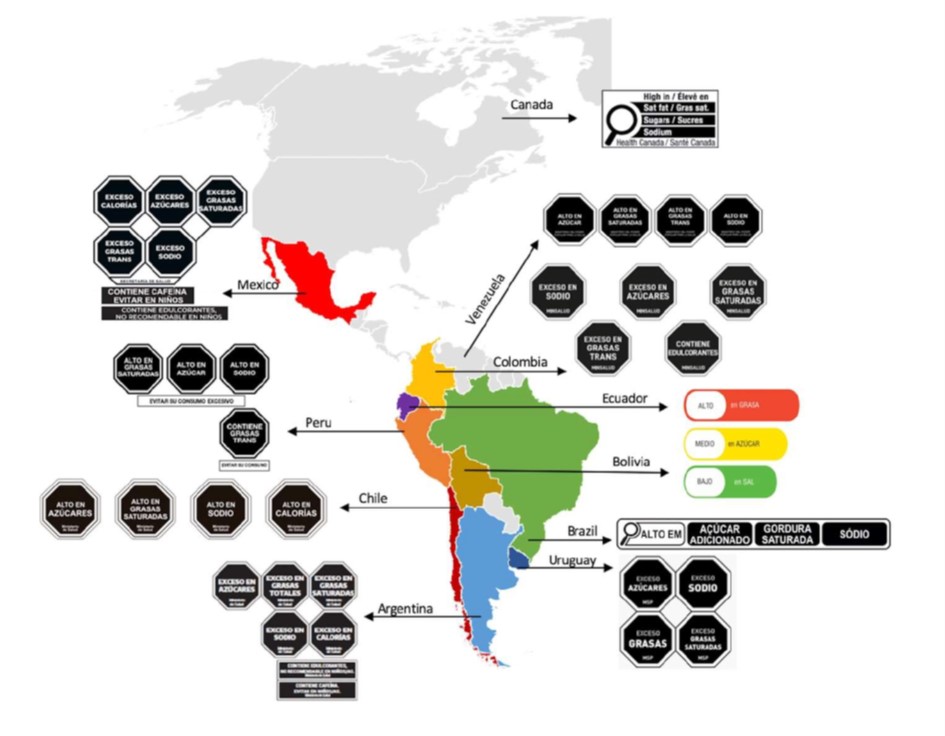
To address the global epidemic of Non Communicable Diseases (cardiovascular diseases, type 2 diabetes, hypertension and some cancers) and malnutrition-related diseases that contribute to mortality and disability worldwide, the World Health Organization (WHO) recommends the implementation of effective front-of-pack nutrition labeling systems that clearly present nutrition information to help consumers make healthier choices. In Latin America, 35 countries have considered front-of-pack nutrition labeling, 30 countries have formally introduced a front-of-pack nutrition labeling system, 11 have adopted a system, and seven countries (Argentina, Chile, Ecuador, Mexico, Peru, Uruguay and Venezuela) have implemented a system.

Over the past decade, policies for front-of-pack nutrition labeling schemes have begun to spread rapidly around the world, particularly in Latin America. Policy adoption for such a system began in Chile (2012), followed by Peru (2013), Mexico (2014), Ecuador (2014), Bolivia (2017), Uruguay (2019), a reformulated system in Mexico (2020), Brazil (2020), Venezuela (2020, 2021), Colombia (2021), and Argentina (2021).
Food and nonalcoholic beverage labeling systems in the Americas
In our country, the current modification came into force on October 1, 2020, resulting in a resounding change in the aspect of food packaging and labeling, moving from the Daily Dietary Guidelines or GDA's, commonly known as stacks, to a system of octagonal seals emphasizing 5 critical nutrients and precautionary legends referring to the ingredient or origin of the ingredient that, based on recognized scientific information, is associated with actual or potential risks related to digestive intolerance, allergies or metabolic diseases or toxicity, following PAHO food classification criteria.

The implementation will be carried out in three phases, first phase from October 1, 2020 to September 30, 2023 (3 years), second phase from October 1, 2023 to September 30, 2025 (2 years), third phase from October 1, 2025.

Within 180 calendar days after its publication in the Official Gazette of the Federation, the Ministry of Economy and the Ministry of Health will jointly determine, and within the scope of their respective competencies, the appropriate indicators with quantitative or qualitative data that allow evaluating and technically supporting the results in the implementation of this amendment. Each of the three phases shall be evaluated separately through the application of such indicators as soon as they are concluded, in the understanding that the last one will be carried out with the data obtained as of September 30, 2028.

The results will be disseminated and made publicly available within six months following the conclusion of each period.
For the first phase, the following nutrient profiles are considered


Energía

Azúcares

Grasas saturadas

Grasas trans

Sodio

Sólidos en 100g de producto

≥ 275 kcal totales

≥ 10% del total de energía proveniente de azúcares libres.

Se exceptúan de sellos las bebidas con < 10 kcal de azúcares libres

≥ 10% del total de energía proveniente de grasas saturadas

≥ 1% del total de energía proveniente de grasas trans

≥ 350mg


Bebidas sin calorías:

≥ 45 mg

Líquidos em 100 mL de producto

≥ 70 kcal totales

o

≥ 10 kcal de azúcares libres

Leyenda a usar

Exceso calorías

Exceso azúcares

Exceso grasas saturadas

Exceso grasas trans

Exceso sodio


For the second phase, the following profiles will be considered


Energía

Azúcares

Grasas saturadas

Grasas trans

Sodio

Sólidos en 100g de producto

≥ 275 kcal totales

≥ 10% del total de energía proveniente de azúcares libres.

≥ 10% del total de energía proveniente de grasas saturadas

≥ 1% del total de energía proveniente de grasas trans

≥ 1mg de sodio por kcal
o
≥ 350 mg
Bebidas sin calorias:
≥ 45 mg de sodio

Líquidos em 100 mL de producto

≥ 70 kcal totales

o

≥ 8 kcal de azúcares libres

Leyenda a usar

Exceso calorías

Exceso azúcares

Exceso grasas saturadas

Exceso grasas trans

Exceso sodio


The first major transformation brought about by front-of-pack warning labeling in Mexico, just one year after its implementation (December 2, 2021), has been product reformulation, showing that the labeling is working.

According to information reported by companies such as Nestlé, Coca-Cola, PepsiCo, Bimbo, Lala and Kellogg's, by 2020, the year NOM 051 went into effect, approximately 56% of their products would have been restructured and reformulated to offer lower amounts of sugars, sodium and fat.

According to the national labeling survey conducted in late 2020, 74% of respondents said they approve of front-of-pack warning labeling, 72% reported that it is understandable to consumers, and 72% also found labels helpful in making decisions about the products they consume, with the sugar label being the most influential octagon in purchase decisions, according to Mexicans surveyed.

In the latest National Health Survey (Ensanut 2021), an estimate was made of packaged food labeling. What was found is that 89.4% of the adults surveyed saw the new warning system, 44.2% of the respondents could identify the less healthy food with this system; 60.5% indicated that this new warning labeling system is helpful for parents to choose healthier foods for their children. Regarding regular consumption of food groups, it was found that a significant proportion consumes undesirable foods such as sugary drinks (69.3%). Finally, from venous blood samples, the prevalence of diabetes in adults was 15.8%; 5.4% were found in the survey. Of 32.1% of the population with high cholesterol, 18% had no diagnosis, and of 51.4% with high triglycerides, 35.9% were unaware of this condition.

According to PAHO - Pan American Health Organization, the Mexican model is the simplest and easiest to understand, besides the fact that this measure was awarded by the UN interagency group, which recognized the Ministry of Health and was also recognized by UNICEF and FAO. The disadvantage is that in some cases, especially in small packages, the essential nutrients are not identified because of the way they have to be labeled. 

Sources:
Crosbie, Eric; Gomes, Fabio; et al, Policy Study on Front-of-Pack Nutrition Labeling in the Americas: Evolution and Results, 2022.
National Nutrition and Health Survey, 2021
 
Connect with us!
 
© TÜV Rheinland 2026
 
Back to top